She talked with some other costumers as well, so it's not just about me.

Friday, 26 June 2015
Me on video from Anaheim
So while at Celebration Anaheim I met up with Holly from "How stuff works". Holly is a wonderful costumer herself, but here she was the reporter. After some mishaps, and trying to connect with each other, while I couldn't really use my phone, she interviewed me in my gold handmaiden costume.
She talked with some other costumers as well, so it's not just about me.
She talked with some other costumers as well, so it's not just about me.

Wednesday, 24 June 2015
Vika traditional costume
As I mentioned in my last post I wear the traditional costume of Vika parish outside Falun in Dalarna, Sweden. My family on my father's side can trace its history there back to the Middle Ages, and eventhough my great grandfather moved away from the area, it was only fitting that when my parents moved to Falun they chose a part of town that is part of the Vika parish. The Vika costume was reconstructed/created in the 1920's. Falun was a fairly affluent town, and the people of Vika had preferred to keep up with current fashions rather than keep with traditional costumes. When it was decided to reconstruct a costume for Vika they did look around in attics and outhouses, as well as talked to older women. They did find a remnant of the fabric that according to a woman had been in use in Vika, and that was to form the foundation for the costume. Vika is a fairly small parish, and there has never been a consistent production of the costume, so it's not a very common costume. The fabric is made by some women, and they set the loom for it when it's deemed that enough people have said that they are interested in a costume. As such it's been hard trying to find pictures of the costume. And I don't have many of myself wearing it either.
The one thing I love about this costume is the colouring. Most traditional costumes tend to go towards black and red, but this one is striped in blue, green and purple. The striping is different on the gown and the apron, so that the apron appears more green while the gown itself is more blue.
The main gown is fairly basic, typical of reconstructed costumes. It's a bodice with lacing in front and the skirt is pleated and sewn on to the bodice at the waist. The gown should be go down to around mid calf, but the length of the skirt is one way of determining when a folk costume was made. There are examples of costumes from the 1960's and 1970's where the skirt barely goes down below the knees. One of the issues I want to fix on my costume is that it's too long and almost goes down to the toes.
Under the gown you wear a linen blouse, with lace around the cuffs and lace inserts on the middle of the sleeve. With the gown you wear a cap and a neckerchief. This is another thing that I like about the Vika costume. Many costumes have regulated how the cap and neckerchief should look, but in Vika they decided to keep the tradition of individual caps and neckerchiefs. The tradition comes from the fact that the neckerchief was usually a gift from your fiance, and depending on how rich or well traveled he was there was a great variety in neckerchiefs, and the cap should go with the neckerchief.
As you can see I have a purple neckerchief and purple cap to go with it. Me and my sisters are all wearing neckerchiefs that were bought when we were very young, it was the first part of the costume that we all received. They are actually from Seefeld, Austria, and are originally worn with the traditional Tyrolean drndl-costume. I've grown up in a family with a lot of friends in that area of Austria/Northern Italy, and I'm very happy that I can combine that part of my family's story together with the heritage of Vika.The neckerchief is held together with a silver brooch in the shape of the coat-of-arms of the Vika parish.
The cap (bindmössa) is a staple of many folk costumes. It can trace its lineage all the way back to the Middle Ages and the structured hoods, including the French hood of the Tudor times. It's hard and structure and covered in embroidered silk. Its shape today is a fossilized version of the caps worn in the 18th century.Around the edge of the cap there is a loose piece of lace, which I think is meant to keep the hair neat, I personally think it's the trickiest part of the costume.
As an unmarried woman I don't need the cap, but can wear a woven ribbon in the same colours as the ribbons to the apron, but I prefer to wear the cap, even if it's trickier to keep in place, I simply feel that the costume is more complete when worn with the cap.
The one thing I'm missing from my costume is the pocket, or loose bag. It's exactly the same shape as a 18th century pocket and embroidered. There is the hitch. I have the material for the pocket, but the stitches are so small that I've never managed to do it myself. Thankfully my older sister, who has sewn my costume, has now said that she can do the embroidery on the pocket for me, so one day I'm going to have a pocket.
There are also some other accessories for the costume. I have a wool winter shawl, white with narrow stripes of purple and green at the border. I also think that I have a simple cotton neckerchief, or at my sister has the fabric for one and she said that she might have ordered fabric for all of us at the same time. For real solemn occasions, like funerals, you can wear a white apron and neckerchief, but I don't have those.
As for things I would like to do do for the heirloom challenge. As mentioned I think my skirt is a bit on the longer side, so I would like to hem it up. I also think that the bodice is too big, I would like to turn it into a more fitted bodice. In order to do that I would need to take it apart and resew it, but I don't think it's very complicated. If I have fabric for the cotton neckerchief it would also be suitable to finish that one.
 |
| A Vika costume, picture from an auction site |
The main gown is fairly basic, typical of reconstructed costumes. It's a bodice with lacing in front and the skirt is pleated and sewn on to the bodice at the waist. The gown should be go down to around mid calf, but the length of the skirt is one way of determining when a folk costume was made. There are examples of costumes from the 1960's and 1970's where the skirt barely goes down below the knees. One of the issues I want to fix on my costume is that it's too long and almost goes down to the toes.
Under the gown you wear a linen blouse, with lace around the cuffs and lace inserts on the middle of the sleeve. With the gown you wear a cap and a neckerchief. This is another thing that I like about the Vika costume. Many costumes have regulated how the cap and neckerchief should look, but in Vika they decided to keep the tradition of individual caps and neckerchiefs. The tradition comes from the fact that the neckerchief was usually a gift from your fiance, and depending on how rich or well traveled he was there was a great variety in neckerchiefs, and the cap should go with the neckerchief.
 |
| Me and my niece in 2008, she's wearing a girl's Leksand costume |
 |
| 18th century cap in a similar style |
As an unmarried woman I don't need the cap, but can wear a woven ribbon in the same colours as the ribbons to the apron, but I prefer to wear the cap, even if it's trickier to keep in place, I simply feel that the costume is more complete when worn with the cap.
The one thing I'm missing from my costume is the pocket, or loose bag. It's exactly the same shape as a 18th century pocket and embroidered. There is the hitch. I have the material for the pocket, but the stitches are so small that I've never managed to do it myself. Thankfully my older sister, who has sewn my costume, has now said that she can do the embroidery on the pocket for me, so one day I'm going to have a pocket.
There are also some other accessories for the costume. I have a wool winter shawl, white with narrow stripes of purple and green at the border. I also think that I have a simple cotton neckerchief, or at my sister has the fabric for one and she said that she might have ordered fabric for all of us at the same time. For real solemn occasions, like funerals, you can wear a white apron and neckerchief, but I don't have those.
As for things I would like to do do for the heirloom challenge. As mentioned I think my skirt is a bit on the longer side, so I would like to hem it up. I also think that the bodice is too big, I would like to turn it into a more fitted bodice. In order to do that I would need to take it apart and resew it, but I don't think it's very complicated. If I have fabric for the cotton neckerchief it would also be suitable to finish that one.
Sunday, 21 June 2015
Midsummer and folk costume
On Friday it was Midsummer's Eve, which is a really big thing in Sweden, and even bigger if you live in Dalarna, the region of Sweden that is the most serious about Midsummer traditions. Now I didn't do anything particular this year, we had a family lunch and then it was off to Vika to raise the Maypole/Midsummer pole and hear a speech about how great the summer is. It is a time to wear the traditional folk costume though, which me, my mother and one of my sisters did.
 It was typical Swedish Midsummer weather as you can see by me and my sister wearing our wool winter shawls over the rest of the costume. My mother isn't wearing her headpiece either because it rained for a lot of the time and she didn't want to ruin it, it's quite a complicated thing out of hay and topped with a very finely pleated piece of fabric.
Since my plan for the HSM Heirloom challenge is to do some alterations on my costume I felt that this would be a good chance to go through some of the history of the costume. By looking at the picture above you can see that my and my my sister are not wearing the same costume as our mother. That is because you usually choose your costume based on the parish that you are from. My family on my father's side can trace our history back to the 14th century in Vika, outside of Falun in Dalarna, so for me and my sisters it was natural to choose the Vika costume. My mother though is from the county of Södermanland and is wearing a costume from Vingåker.
The history of the folk costume is quite complicated. Basically from the start it was used in most Swedish parishes, with each parish having its won version. My mother's Vingåker costume is one of the oldest unchanged ones in Sweden, there were regulations already at the end of the 16th century that you were not allowed to do any changes to it. During the 18th century the costumes started to deviate more from the current fashions, looking at many folk costumes you can still see fossilized remains of 18th century fashion. This also meant that the traditional costumes survived more in rural communities, people of the higher classes and people in towns preferred to keep up with fashions rather than tradition. Where the traditional costume stayed alive it usually developed a very complicated system of colours and accessories and how to wear the costume correctly. One of the most complicated costumes is the one from Leksand, Dalarna, where there is even a published calendar on how to wear and combine the different parts of the costume correctly, if you have more than the basic costume.

When talking about folk costumes nowadays you usually differ between costumes with an unbroken tradition and reconstructed costumes. An unbroken tradition means that the costume has been in use up until the early 20th century, most costumes are reconstructed ones though. That means that the use of traditional costume disappeared in the 19th century, but when the wave of romantic nationalism swept over Sweden in the early 20th century they were reconstructed to and people started wearing them again. Some costumes were reconstructed, with the help of textile remnants and oral traditions, other were totally constructed out of a general "this would represent our parish"-feeling. I personally am trying to get away from looking down "new" or reconstructed costumes, not the least because many of them date to the 1920's and 1930's and have acquired a history as well, even if it's not as long as the unbroken costumes.
The traditional costumes are mostly associated with Midsummer, but can be worn for all occasions, they are considered formal wear. I've worn mine for example when singing with the church choir at Christmas and to balls when I was a student.

In the next post I'll talk a bit more about my costume.

Since my plan for the HSM Heirloom challenge is to do some alterations on my costume I felt that this would be a good chance to go through some of the history of the costume. By looking at the picture above you can see that my and my my sister are not wearing the same costume as our mother. That is because you usually choose your costume based on the parish that you are from. My family on my father's side can trace our history back to the 14th century in Vika, outside of Falun in Dalarna, so for me and my sisters it was natural to choose the Vika costume. My mother though is from the county of Södermanland and is wearing a costume from Vingåker.
 |
| Costumes from Vingåker, note the headpiece |

 |
| varieties of the Leksand costume, http://www.hembygd.se/tallbergs-byalag/leksandsdrakten/http://www.hembygd.se/tallbergs-byalag/leksandsdrakten/ |
When talking about folk costumes nowadays you usually differ between costumes with an unbroken tradition and reconstructed costumes. An unbroken tradition means that the costume has been in use up until the early 20th century, most costumes are reconstructed ones though. That means that the use of traditional costume disappeared in the 19th century, but when the wave of romantic nationalism swept over Sweden in the early 20th century they were reconstructed to and people started wearing them again. Some costumes were reconstructed, with the help of textile remnants and oral traditions, other were totally constructed out of a general "this would represent our parish"-feeling. I personally am trying to get away from looking down "new" or reconstructed costumes, not the least because many of them date to the 1920's and 1930's and have acquired a history as well, even if it's not as long as the unbroken costumes.
The traditional costumes are mostly associated with Midsummer, but can be worn for all occasions, they are considered formal wear. I've worn mine for example when singing with the church choir at Christmas and to balls when I was a student.

In the next post I'll talk a bit more about my costume.
Sunday, 14 June 2015
Lack of inspiration, lack of updates
So it's been two weeks since I posted anything, and to be honest it's quite a lot to do with lack of inspiration. I've also had some really busy weeks at work, end of May early June is always my busiest since I simultaneously have a lot of special school programs and prepare the upcoming summer season. This year, and the coming years, it's also the preparation for opening up our new exhibitions. This year it was the first part, showing off the history of the Falun Mine from the start (somewhere around 1000 AD) to ca 1530.
 Part of my job with the new exhibit has been with choosing weapons and clothing that the visitors will see and be able try out. Well the weapons will be mounted on the walls, but I couldn't resist having some fun with them before they went up. For clothing I, together with the seamstress we hired, decided to go for late 14th century. It has the traditional "medieval" look of them, and we wanted to use a fairly non-fitting style, so that people of as many sizes as possible would be able to try them. In the end we have a mix of tunics, cotes, surcotes, cape and hood based on the Greenland finds and the clothes worn by Bockstensmannen.
 The lightning in the exhibition isn't exactly good for taking photos, but it's possible to get some dramatic shots there.
Except for work I've also felt quite uninspired by this months HSM challenge. Or rather it hasn't turned out as fun as I wanted to. The challenge is "out of your comfort zone" and I'm still planning on drafting and handsewing a pet en l'air. Being back in the 18th century after my early 1900s clothes have made me feel that they are more constricting, and not the least that I need to wiggle in and out of my backlaced stays every time I want to do a fitting, my dress form is perfect for modern clothes and the hourglass shape of the 19th century, but unusable for the more conical shape of the 18th century.
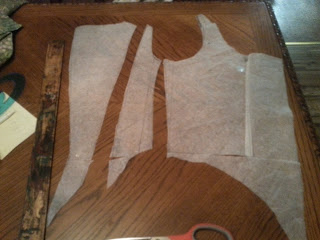 This is where I'm at after having drafted the pattern from the instructions for a late 18th century bodice in Creating Historical Clothes.
Hopefully I can get some inspiration and get over the hurdle of creating the pattern, because I really want to start working with the fabric that I have for it.


Except for work I've also felt quite uninspired by this months HSM challenge. Or rather it hasn't turned out as fun as I wanted to. The challenge is "out of your comfort zone" and I'm still planning on drafting and handsewing a pet en l'air. Being back in the 18th century after my early 1900s clothes have made me feel that they are more constricting, and not the least that I need to wiggle in and out of my backlaced stays every time I want to do a fitting, my dress form is perfect for modern clothes and the hourglass shape of the 19th century, but unusable for the more conical shape of the 18th century.

Hopefully I can get some inspiration and get over the hurdle of creating the pattern, because I really want to start working with the fabric that I have for it.

Monday, 1 June 2015
measurements
One thing about sewing that I both dislike and like is that it's necessary to know your measurements. It gives a good reality check though, knowing that this is actually my body. Also it makes it easier to notice any changes, more reliably than standing on the scales.
Well since I'm hoping to draft and drape a saque pattern this month I needed to take all my measurements in my desert rose stays. Thankfully my sister dropped by so I could get some help, I've found it impossible to get accurate measurements when trying to measure myself. Since I also don't trust that I will keep hold on the little note where we wrote everything down I'm going to share my measurements with you all. The numbers correlate to the numbers in Creating historical clothes, so I'm not going to tell you exactly which body part has which measurement.
Well since I'm hoping to draft and drape a saque pattern this month I needed to take all my measurements in my desert rose stays. Thankfully my sister dropped by so I could get some help, I've found it impossible to get accurate measurements when trying to measure myself. Since I also don't trust that I will keep hold on the little note where we wrote everything down I'm going to share my measurements with you all. The numbers correlate to the numbers in Creating historical clothes, so I'm not going to tell you exactly which body part has which measurement.
- 162
- 36
- 40
- 104
- 67
- 84
- 120
- 15
- 47
- 70
- 35
- 27,5
- 16
- 46,5
Saturday, 30 May 2015
A kind of Edwardian hat
So at the Railway museum I wore quite a large hat. The thing with the hat is that I'm not too happy with the details of it, but the sum is larger than the parts and I just loved walking around this big hat, and I got quite a few compliments on it as well.
It all started with this hat, that I prepared at the hat making day earlier in April.
 In the end I felt that I had cut down the crown too much, and it didn't feel very Edwardian, definitely more Georgian.
In the end I found a last remnant of tulle and piled it on top of the hat.
 Then I covered the tulle with some silk habotai that I found in my stash. Then I went with the "more is more" approach and added the last tulle, some silk flowers that I usually have as decorations in my living room and some ostrich feathers.
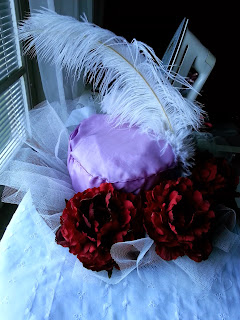 The hat was held in place with some hat pins, but I need to practice putting them in a better position to really hold the hat steady. Still it stayed on the whole day, despite some gusts.

It all started with this hat, that I prepared at the hat making day earlier in April.

In the end I found a last remnant of tulle and piled it on top of the hat.


Wednesday, 27 May 2015
HSM15: Challenge 5 - Practicality
What the item is (and what practical things you can do in it):
For the Practicality challenge I decided to make a shirtwaist, suitable for the first decade of the 20th century. At the beginning of the year I didn't have a plan for this challenge, but then I got invited to attend the 100th anniversary of the National Railway Museum, with a theme of 1900-1915. In the end the finished garment fitted the challenge in two different ways.
The shirtwaist in the end of the 19th century came to be almost a uniform for the respectable and independent working woman. From the beginning the shirtwaist had been modeled after men's shirts, but at the end of the 19th century application, embroideries and other detailing could be added to make it into a fashionable item.
For the bodice of the shirtwaist I used the instruction in Text-book on domestic arts from 1911. Then I looked quite a lot for inspiration pictures, since I wanted to go for a ca 1900 look. The pattern was easy enough to modify for an earlier look. I wanted to add detailing to the front, that wasn't in the instructions, so I simply added extra length to the bodice fronts and pleated them down in the front. The pleats fanned out from the neck down to make the shirtwaist fit snug at the neck, but be roomy over the bust and give some poufing when tucked in at the waist. For the sleeves I used the two piece sleeves from TV493. That's a fitted sleeve, but I cut out the largest size to give it extra width. That meant that I then had to take it in at the wrists, but the should fit very well. The collar was also taken from TV493, but made higher. It was constructed of one of the fashion fabric and one layer of heavy white cotton. The cotton is actually an antique bedspread from my great grandmother, so it's probably around 100 years old. The lace on it is shredded and the cotton has been worn out in many placed, but it's perfect to use for small pieces where you want a nice heavy cotton. I also love using these antique things since it gives a nice connection back in time. The cuffs were simply a length of fabric folded double and attached to the end of the sleeve. It's closed with 10 buttons in the front and a button each on the cuffs.
Putting the pieces of the bodice was easy. Most of the shirtwaist is actually handsewn. Not because of a wish to make it more accurate, since sewing machines were around at the time, but simply because I was up in the mountains and didn't have access to a sewing machines. I've also learned to make button holes by hand now. They aren't perfect, but they work and look just as good as when I do them on the machine. It was good practice to make it by hand, since I could practice stitches, but since it's not a very tight garment the seams won't take a heavy strain so I don't have to worry about the strength of my seams.

The shirtwaist turned out to be such a comfortable and practical garment. Coming from 18th century upper class clothing, it was so wonderful to have full range of movement in the arms and it was easy to close with the buttons in front.
I also found it to be a very practical pattern. Under the shirtwaist I'm wearing a corset cover and a chemise made from the same basic bodice pattern. The only difference is the extra pleating on the shirtwaist and the deeper neck opening on the corset cover and chemise. It's so practical to have a basic pattern that can then be tweaked to fit whatever you need it for. I'm definitely going to use it again, if I make more clothes for this era, since it's so simple and the possibilities to adapt it are almost endless.
The Challenge: 5 - Practicality
Fabric: 2m of embroidered cotton, 10 cm of antique heavy cotton
Pattern: Adapted from shirtwaist from the Text-Book on Domestic Art, combined with modified sleeves and collar from TV493.
Year: ca 1900
Notions: regular sewing thread, buttonhole twist, 12 buttons, 0,5 m cotton lace for the neck
How historically accurate is it? As far as I know it's accurate both in pattern, choice of fabric and techniques used.
Hours to complete: Handsewing took some time so probably 25-30
First worn: May 23, the Swedish National Railway Museum's 100th anniversary
Total cost: $45
For the Practicality challenge I decided to make a shirtwaist, suitable for the first decade of the 20th century. At the beginning of the year I didn't have a plan for this challenge, but then I got invited to attend the 100th anniversary of the National Railway Museum, with a theme of 1900-1915. In the end the finished garment fitted the challenge in two different ways.
The shirtwaist in the end of the 19th century came to be almost a uniform for the respectable and independent working woman. From the beginning the shirtwaist had been modeled after men's shirts, but at the end of the 19th century application, embroideries and other detailing could be added to make it into a fashionable item.
For the bodice of the shirtwaist I used the instruction in Text-book on domestic arts from 1911. Then I looked quite a lot for inspiration pictures, since I wanted to go for a ca 1900 look. The pattern was easy enough to modify for an earlier look. I wanted to add detailing to the front, that wasn't in the instructions, so I simply added extra length to the bodice fronts and pleated them down in the front. The pleats fanned out from the neck down to make the shirtwaist fit snug at the neck, but be roomy over the bust and give some poufing when tucked in at the waist. For the sleeves I used the two piece sleeves from TV493. That's a fitted sleeve, but I cut out the largest size to give it extra width. That meant that I then had to take it in at the wrists, but the should fit very well. The collar was also taken from TV493, but made higher. It was constructed of one of the fashion fabric and one layer of heavy white cotton. The cotton is actually an antique bedspread from my great grandmother, so it's probably around 100 years old. The lace on it is shredded and the cotton has been worn out in many placed, but it's perfect to use for small pieces where you want a nice heavy cotton. I also love using these antique things since it gives a nice connection back in time. The cuffs were simply a length of fabric folded double and attached to the end of the sleeve. It's closed with 10 buttons in the front and a button each on the cuffs.
Putting the pieces of the bodice was easy. Most of the shirtwaist is actually handsewn. Not because of a wish to make it more accurate, since sewing machines were around at the time, but simply because I was up in the mountains and didn't have access to a sewing machines. I've also learned to make button holes by hand now. They aren't perfect, but they work and look just as good as when I do them on the machine. It was good practice to make it by hand, since I could practice stitches, but since it's not a very tight garment the seams won't take a heavy strain so I don't have to worry about the strength of my seams.

The shirtwaist turned out to be such a comfortable and practical garment. Coming from 18th century upper class clothing, it was so wonderful to have full range of movement in the arms and it was easy to close with the buttons in front.
I also found it to be a very practical pattern. Under the shirtwaist I'm wearing a corset cover and a chemise made from the same basic bodice pattern. The only difference is the extra pleating on the shirtwaist and the deeper neck opening on the corset cover and chemise. It's so practical to have a basic pattern that can then be tweaked to fit whatever you need it for. I'm definitely going to use it again, if I make more clothes for this era, since it's so simple and the possibilities to adapt it are almost endless.
The Challenge: 5 - Practicality
Fabric: 2m of embroidered cotton, 10 cm of antique heavy cotton
Pattern: Adapted from shirtwaist from the Text-Book on Domestic Art, combined with modified sleeves and collar from TV493.
Year: ca 1900
Notions: regular sewing thread, buttonhole twist, 12 buttons, 0,5 m cotton lace for the neck
How historically accurate is it? As far as I know it's accurate both in pattern, choice of fabric and techniques used.
Hours to complete: Handsewing took some time so probably 25-30
First worn: May 23, the Swedish National Railway Museum's 100th anniversary
Total cost: $45
Subscribe to:
Posts (Atom)