Showing posts with label books. Show all posts

Thursday, 29 January 2026

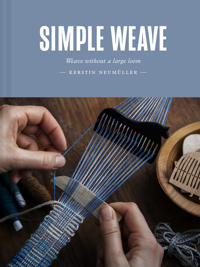
Simple weave by Kerstin Neumüller

Throughout January I have read a lot of tutorials and seen a lot of youtube videos on how to weave bands with a heddle backstrap (bandgrind in Swedish). I had it figured out, but since I have a tendency to run before I can walk I felt that maybe I needed to invest in a book on the subject. I had put in a reservation in my library for a book about it, but I am number 2 in the reservation queue so it will be a while until I can get my hands on it. There are a a number of books on bandweaving but in the end I decided to buy "Simple weave" by Kerstin Neumüller. It is available both in Swedish and English. I chose this book because it was the cheapest, and it was available as an ebook, so that I could get my hands on it instantly.


I had a feeling that the book wasn't quite what I needed and I was right. The book itself is an introduction if you are interested in starting with weaving, but without having to start with having a large loom. There is a focus on the backstrap heddle, but only one short section about making traditional patterned bands, what I am interesting in. I think that since there are quite a few books out there about just band weaving, then the focus was on other techniques, like weaving kelim and images and moving on to backstrap looms. Still the few pages on  patterns was exactly what I needed to get a clear idea on how I am supposed to warp up to make the patterns. It also had nice explanations of yarn weight and how to create striped bands. Overall the language and instructions are very clear and easy to follow, and that is the best part of the book.

One thing I missed was pictures. I suppose it's a budget issue, but the images are mostly hand drawn sketches, and for the band themselves it would have been really nice to see what they looked like when finished, not just on grid pattern. 

So all in all the book gave me a few hints and advice that I hadn't picked up on free web resources, but if you are willing to scour the web you will be able to start fine without this book. It is a book that is better suited for those interested in weaving, but not if your main focus is to make traditional bands. I will probably pick up a book that is just about band weaving in the future, as of now I will use this to try and make my first patterned band, and have it handy when I get curious on how to finish the bands. 


Monday, 24 March 2025

Constructing a 16th century bodice with the bara system

 So I have said that before I make my next bodice, gown, or whatever I need to make a pattern that actually fits well. I wanted to restart from scratch rather than using my old pattern pieces. Since I made my first 16th century gown I had also heard about the magic of a curved front bodice, that can support the bust, and the bara method. 

Well it was time to see what I could do. The first explanation of making a curved bodice pattern was in a landsknecht facebook group, and that started with a modern bodice that fit well, and then you altered that to remove darts and princess seams. Well I haven't sewn a modern bodice in a long time, and it looked just as fiddly as starting something from scratch. I then found this pattern and tutorial on Magnifica Sylvie la chardonnière blog - Research dumping grounds. I will say this even if I personally haven't felt attracted to the SCA, as an historical costumer I am very much indebted to all the wonderful people in that group who share their knowledge freely with us all through their blogs.

The pattern was built around the "bara"-system. I had heard about it and now I decided that it was time to dwelve into it. The bara system is a measurement and pattern system as used in Spanish manuals from the late 16th century. Mathew Gnagy of The Modern Maker has created a modern instruction on how to use it and published patterns based on it. The basics of it is that you use your own measurements (chest, waist, hip and length) and create a tape for each measurument, that tape is then divided into pieces (quarters, thirds and so on) and since it is all based on your own measurements it makes it possible to make a proportional pattern only using those four tapes. He explains everything in his book "The Modern Maker volume 2"  I also bought volume 1, since I didn't quite understand which one was best. Volume two is all about creating the pattern and lets you set up your own bara system and then use that for several patterns, the volume one is about construction one specific garment, a man's doublet and has more information about the construction of the garment. There is also a volume 3 that is all about the handsewing techniques needed, but I haven't bought that one (yet). In order to make your own bara and understand the pattern drafting you need to buy the Volume 2. 

So on Sunday me and my friend Emma set out to create our bara measurements and make a bodice pattern.

Creating the different bara tapes was quite straight forward, but it was good to have one person doing the dividing of the tape, and one person reading what should be done and then mark it. When doing the third tape it happened that I said "I know what's next", and then Emma said "no, it's this step".

There was one measurement we had a problem with, but thankfully the Research dumping ground pattern had a mathematic formula that we used to calculate it. Then it was an issue of measuring and drawing out lines and connecting the dots. The one issue we had from the bodice pattern was how to find out where to put the waistline on the front, but with the help of the book rather than the pattern we figured it out.

This was my first draft of the bodice, and it is the best bodice pattern I have made. If the plan was to make an overgown I would just have scooped out the neckline and made the armholes larger (I hadn't been too careful when drawing them out so that they ended up small has more to do with me than the pattern).


I want this to be a bust supporting underkistl though, so I needed to get it tighter. To help with the fitting I added a zipper in one of the side seams, so that I could really sew the front closed, and not just pin it to fit. I definitely needed my husband to help me close the zipper, so even if I do the fitting myself it is a two peson job, and knowing that I should probably have put the zipper in the back so that I could fudge with the side seams as well. During this process I also decided that this kirtle will have be closed in the sides, since I haven't done that before and I hope that will help with creating a smooth and supporting front. I am also doing the fitting over a thin cotton top, since the kirtle will be worn over a shift. The most important thing is that you get a really tight fitting band under the bust that acts as a bra band, and will keep everything else from riding up or down. I could take in around 2,5 cm on each side at the front jus under the bust to get that fit.

My main issue so far is wrinkling over the bust. It starts just over the the tight fitting band. I am starting to think that when I took my chest measurements, I did them too tight, on the other hand all the measurements except the main bust, that is built around the chest measurement fits really well. 


Hee is the first bodice pattern, with an adjusted armscye and neckline, tigher under the bust, you can see the seamlines moving inwards.


Here is the origional paper pattern to the left and the new one to the right. There is a very visible curve outwards over the bust. The next mockup will use this new pattern, and I might also adjust the sideseam to get some more room over the bust


And here are the front and back pattern pieces, I have done no alterations to the back piece since it fit perfectly from the start. I really want this to end up perfect and I am almost there, so I will take the time to make more mockups before cutting out the real pieces. It is already a lot better than the bodices on both my pink gown and mustard kirtle though,


Tuesday, 1 December 2015

Legal and free e-book

I love the University of Århus' policy of publishing a free e-book each month, and this month it's once again time for a book about historical clothes

Link to the free download

This is the official description of the book.

The book tells the exciting story of one of the 20th century's most spectacular archaeological finds: the excavation of the Herjolfsnæs graveyard in 1921 where - because wood has always been extremely scarce in Greenland - bodies had been buried in multiple layers of cast-off clothing instead of coffins.
Just looking at the content it's more than just about the Herjolfsnaes finds, even if those are the focus. It goes through the excavation and the finds themselves, but also finds from other parts of Greenland. After that follows chapters on the different techniques used to craft the garments, from rearing the sheep and goats to the finishing decorations. The book ends with a catalogue of the Herjolfsnaes finds, with new full colour photos of them!

So take your chance and download this book that is really a go to book when it comes to medieval clothing.
  

Monday, 1 June 2015

measurements

One thing about sewing that I both dislike and like is that it's necessary to know your measurements. It gives a good reality check though, knowing that this is actually my body. Also it makes it easier to notice any changes, more reliably than standing on the scales.

Well since I'm hoping to draft and drape a saque pattern this month I needed to take all my measurements in my desert rose stays. Thankfully my sister dropped by so I could get some help, I've found it impossible to get accurate measurements when trying to measure myself. Since I also don't trust that I will keep hold on the little note where we wrote everything down I'm going to share my measurements with you all. The numbers correlate to the numbers in Creating historical clothes, so I'm not going to tell you exactly which body part has which measurement.
  1.  162
  2. 36
  3. 40
  4. 104
  5. 67
  6. 84
  7. 120
  8. 15
  9. 47
  10. 70
  11. 35
  12. 27,5
  13. 16
  14. 46,5

Friday, 27 March 2015

Free publications on fashion

The Metropolitan Museum in New York has a huge library of their publications, through Met Publications, available for free online. There are 54 publications just from the Costume Institute, covering a huge spectrum about fashion and costume history.

Here's the link, don't get lost for too long, I know I want to spend many hours browsing all these publications.

Monday, 2 March 2015

Birthday presents to myself

So just before the championships started I celebrated my birthday, and I bought two presents for myself. Now the presents didn't arrive until a week or so ago, but I'm very happy with them.

The first one is Jill Salen's Corsets. It's been on my wishlist for a long time and I regret that I haven't bought it earlier. I'm pretty confident when it comes to constructing Victorian corsets but I've more or less only used the TV pattern. With this book there are patterns for a lot more corsets, and I definitely feel inspired to make a corset with proper hip gores and cording now. I think what I like the most about the book are the clear illustrations on how to place the boning.

The other present to myself was Janet Arnold's Patterns of Fashion 2. I have the first one, and even if I haven't directly traced any patterns from it I've used it a lot for inspiration and instructions when it comes to constructing the garments. I am starting to feel more and more drawn to late Victorian fashion and with these two books I feel I have a good foundation to start with those kinds of projects.

Thursday, 6 November 2014

Star Wars Costumes - The Original Trilogy

It actually arrived last week on my doorstep, but it's taken some time to fully go through it and absorb it all, and I still haven't really dived into the hard armour costumes.

It is a beautiful book and a must have for a Star Wars costumer. It's about the same size as the Dressing a Galaxy, the book about the prequel costumes. I really enjoyed the forewords from the costume designers, as well as the texts about each costume where they go into the detail on what the costume meant in the development of the character.

As for costume info,well it's clear that it's made for us serious costumers. They are clear to note that for example the picture of the Classic Leia gown is from the ESB gown and not the ANH gown, and that the fabrics in them are different. Just the same there are three folodouts, one for each variation of stormtrooper from ANH, ESB and ROTJ. There simply are lots and lots of details, I would actually say it's more detailed than Dressing a Galaxy.

Another difference to Dressing a Galaxy is the focus on background characters, maybe not so strange when you compare the amount of costumes worn by the main characters in the two trilogies. Here it's a lot about pilots and troopers, so definitely more "male" costumes than in DAG.

My favorite new info is that it actually tells that both Bespin Leia and the Classic Leia are made out of crepe de chine.

The only disappointment was that it's not a single picture of Leia's ceremonial gown, from the end scene of ANH and that the only Leia spread out is of the bikini.

For my personal costumes I now feel that my A-wing pilot is so inaccurate, but I'm stoked to add more details to my Endor trooper. I've totally misjudged how the Endor poncho is constructed, but I still think mine looks good enough.

The costumes featured in the book are:

ANH
Classic Leia
Imperial Officers
Rebel Fleet Trooper
Darth Vader
Stormtrooper
Obi-Wan "Ben" Kenobi
Luke Skywalker, farmboy
sketches of cantina costumes
Han Solo
Chewbacca
C-3PO
Tatooine Protocol Droid
Jawa
Tusken Raider
Death Star Droid (protocol droid)
Imperial Guard & Gunner
TIE pilot
X-wing pilot
Luke's ceremonial pants

ESB
Luke Skywalker - Hoth Uniform
Han Solo - Hoth Uniform (the parka)
Princess Leia - Hoth Uniform
R2-D2
Rebel Commandos (Hoth)
Rebel Officers  & Technicians (Hoth)
Snowspeeder pilots
Snowtrooper
AT-AT driver
General Veer's battle armor
Yoda
Boba Fett
Bounty Hunters
Han Solo
Lando Calrissian - Bespin administrator
Princess Leia - Bespin gown
Bespin Security guard
Luke Skywalker - Bespin fatigues
Stormtrooper MK II

ROTJ
Princess Leia - bounty hunter disguise
Luke Skywalker - jedi knight
Bib Fortuna
Gamorrean Guard
Slave Leia
Lando Calrissian - skiff guard
Skiff guards (humans)
Skiff Guards - Queequeg & Barada
Skiff Guards - (Nikto & Woof)
Skiff guards - helmets
Sandstorm outfits
Mon Mothma
Lando Calrissian - General Uniform
Rebel technicians
The Emperor
Royal Guards
Imperial Dignitary
Rebel Endor Commando
Han Solo - Endor Duster
Luke Skywalker - Endor poncho
Princess Leia - Endor Uniform
Rebel Prune Face
Biker Scout
Princess Leia - Ewok village dress
Ewoks
Darth Vader
Stormtrooper
AT-ST driver
Admiral Ackbar
Rebel Pilots (A-, B-, Y-wing)

Thursday, 25 September 2014

Book advice for September

There are still some days left of September so I want to tell you about the September free e-book from Aarhus University.

It's Medieval Garments Reconstructed by Lilli Fransen, Anna Nørgård and Else Østergård, and basically it's a book that tells you everything you need to know about the finds from Herjolfsnes, Greenland. The finds were done when a cemetery from the Norse colony on Greenland was excavataed. The cold climate had preserved the clothes that people had been buried in, and it is one of the riches sources of medieval clothing, as worn by people in the North in the 14th century. The book contains both the history of the finds, analysis of everything from which kind of wool was use to spin the thread, the loom and not the least patterns on a grid scale. I also found it very nice that they have photos of the reconstructed garments, as well as the original one.

If you are the least interested in medieval clothing, or even just fantasy in a medieval setting, I definitely recommend to use this chance and get a free and legal copy of the book.


Medieval Garments Reconstructed

Tuesday, 8 April 2014

Star Wars Costumes - The Original Trilogy

I just read about this book over at Club Jade, and this is just a must have book for me. This is what the description says:

Who can forget the first time they saw Darth Vader with his black cape and mask? The white hard-body suit of the stormtroopers? Or Leia’s outfit as Jabba’s slave? These costumes—like so many that adorned the characters of that galaxy far, far away—have become iconic. For the first time, the Lucasfilm Archives has unpacked the original costumes to be revealed in breathtaking detail.
Featuring all-new photography, Star Wars Costumes: The Original Trilogy affords both new and longtime Star Wars fans the opportunity to examine the stormtrooper armor and discover how it changed from movie to movie; explore Boba Fett’s suit and inspect the rarely seen details of his blaster and jetpack; compare the helmets and jumpsuits of the rebel fighters; and study the details of the Hoth fighter uniforms.
This lavish large-format book not only showcases high-quality photography of each costume, it also pairs these stunning images with original sketches, behind-the-scenes photographs, production notes, and stories.
 Some of the things written make me think that the writers have spent some time over at the Rebel Legion forums, considering all the discussions about the differences in helmets and flightsuits for the pilots, and not least the fact that there is a 50 page discussion just dedicated to the Hoth troopers.

I'm a bit worried that there will not be enough focus on Leia's costumes, but I really hope that it will contain some new and detailed pics of the Bespin gown, since that is a future dream project.

And I need a companion to Dressing a Galaxy in my costume book shelf.


Thursday, 6 February 2014

Early birthday gifts

It's my birthday in February and I've bought myself two, ok three, birthday gifts this year. Two of them have arrived quicker than I expected so I already have them, even if it's just the beginning of February.

The first thing was the book Creating historical clothes: Pattern Cutting from Tudor to Victorian time by Elizabeth Friendship.
I bought it after reading this review over at American Duchess. I can only agree with the assessment in the review, that the book covers everything, but there are few pictures of actual garments. I've just flipped through it and to be honest all the diagrams and numbers and points seem a bit daunting to me. I'm hoping that once I read through the instructions carefully and just follow them step by step, then it will be a lot clearer. I still think this is the kind of book I need though in order to be able to finally make the patterns I want to, without having to buy new patterns for every single piece. I also like that it covers such a wide time period, since I have promised myself that I am going to make a 17th century outfit one day, and I can't help that I'm dreaming of making a really nice 1880's ensemble as well.

This book together with draping will probably be very helpful. Draping brings me to my major birthday gift to myself. I've finally bought a dressform.
Here she is dressed in my navy anglaise. It was really hard to choose which size I would go for, since I am a bit between sizes, especially when I'm wearing historical undergarments. In the end I decided to go for a medium sized, rather than the small. The dressform actually arrived in less than two days and after assembling it and adjusting it I can only say that it fits my natural measurements great. Unfortunately as you can see I can't close my navy anglaise at the bust. I have adjusted the bust measurements to the smallest available, but my squishy bust is pushed upwards  when I wear stays and this gown, while the dressform of course has a bust that refuses to move. There is also a difference between the navy anglaise, which is on the verge of "I can't breathe" and the printed cotton anglaise which is probably half a size larger, and that one I could close over the bust.

If I want to make something 18th century as tight as the navy anglaise I will simply have to do the final adjustments on my body rather than on the dressform. The reason why the navy anglaise is so tight is also because I used a dressform in size small, and even with padding it was too small compared to myself.

Also even if I'm in an 18th century phase at the moment, I do quite a lot of other clothes as well, and then the dressform can be adjusted to my exact size.


Wednesday, 6 November 2013

Costume Close-up

This little beauty arrived on my doorstep yesterday, and I'm quite excited. Being on a sewing hiatus, I'm not allowed to start any new projects until after Christmas, always seems to make my project lists just grow and grow and grow, I think I'm up to around 10 future costumes that I really want to make now. This book added a couple of more future projects, just by quickly looing in it.

I've always felt a bit scared about resizing patterns from books. In my costume history I have almost always failed miserably with that. I'm starting to think that I'm ready to take this step though, and the reasons for that are:


  • When doing my Snow White costume I worked with a dress form for the first time and it made pinning and trying things so much easier. Before I start with my next sewing project I'm definitely going to invest in a dress form of my own.
  • I have gotten more confident. Also for Snow White I drafted my own sleeve pattern, more or less by combining two previous patterns and it worked out good, so I'm hoping the step to drafting a pattern for a whole garment won't be too impossible.
  • By now I have a pattern for an 18th century bodice that works well on my body. I can frankenstein patterns so that it's almost impossible to recognize what it was from the beginning. Using that bodice pattern as a starting point I don't think it will be too hard to make the garments that I want.

Out of the book there are two patterns that I want to use, and it might help me with a third. My costume plan for 2014, which I'm going to post about later, involves a costume with a redingote/men's inspired jacket. I think that the coat (19) on page 92-96 is very similar to what I'm hoping to do.

Then I love the jacket (6) on page 39-42. I totally understand why some blogs have called it the most reproduced garment, or "that Williamsburg jacket". In other words I would join very many costumers before me who have done this jacket, and there are a lot of pictures and tutorials for it out there. One little thought that is tingling in the back of my mind is if I should try and sew it by hand. I'm probably never going to be a perfect recreator and only use period techniques, but a jacket isn't very big and it could be fun to have a garment that I've made all by hand. I might aim for this jacket for 2015.

To finish off I have started to think about doing a proper robe à la française or sacque-gown. I've never been particularly fond of this style, but I saw so many nice costumes at the Masquerade in Kalmar that I started thinking about making one. Also my sister has always drooled over this style, and if I can finally persuade her to make an historical costume it would be probably be this kind of gown, and it could be fun if we made a project together.