Showing posts with label viking. Show all posts

Sunday, 11 July 2021

A viking day

 Just like last summer my friends at Ingvara have set up a viking camp outside of Rättvik. Yesterday me and the regular group from the 16th century guild decided to go up there and be vikings for a day. With all bigger events still being cancelled we were all longing for some historical living. The weather forecasts looked really grim, basically rain all day, but we still decided to go through with the planned visit.

This year the camp was situated a bit further down the meadow, and they had built an two additional wooden houses, so not just tents. The location meant that it was in sheep and horse meadow, but unfortunately the chicken stayed closer to the modern houses and didn't run around in the camp.

There was plenty of crafting going on, with Kål-Henrik and Marlein made it showing and teaching sprang weaving. I had a new gown that I worked on, and I'm going to make a post about it soon.

I love the chance of cooking though, so I was really happy to be in the kitchen. We were making an ale-elk (ale-älg in Swedish) stew and a root vegetable stew with three different kinds of onions. I had also brought with me a sourdough from rye and spelt wheat. Unfortunately this is where the weather gods decided that they had given us enough good weather despite the forecast. When we had the pots going on the fire the heavens just opened up. We couldn't make bread, because the skillets we used go too wet, and the stews also got really watered down from the rain. The meat was still ok. We huddled for a while in the more permanent house and when the weather cleared up again I packed up and went home.

The last few times that I have worn my apron dress I have been annoyed that it feels too tight and long. So when I went home I simply chopped off 15 cm of it and rehemmed it. 

Sunday, 19 July 2020

Overnight stay at the viking camp

On Saturday I started my summer vacation. Work has been really busy the last two weeks and I felt that I needed to just go off somewhere and shut it off. I heard with the people at Ingvara Viking, that I visited on June 6th, and I was welcome to come and stay over night as well Saturday-Sunday.

I wore my only viking outfit, so the same as on June 6th, but for the evening I added an amber necklace that I have.


I did feel fancy though since Sofia, the daugher of one of the owners, is very good with doing viking hairstyles, so she braided my hair.


The lambs that were newborn when I visited in June had grown a bit now.


Of course I wanted to cook and do food preparations. I had brought with me two sets for making cheese. For Saturday evening I made a cheese by curdling whole milk and cream with vinegar. That one drains pretty quick so it only takes an hour or so.


The other cheese was made by heating up sour milk (filmjölk) with a bit of sour cream (gräddfil) and then let it drain over night, so we had it for breakfast in the morning. The taste was pretty similar with the different methods, but the sourmilk one had a consistency that was closer to cream cheese while the milk and vinegar one gets grainier, almost like a crumbly feta style cheese. I'm not sure yet which style I prefer.

I got to sleep over in a corner of the stable, that they use as their shop. I had brought a modern sleeping bag and a wool underwear set. I also had my Enfys Nest cape and a sheep skin as blankets. I didn't feel cold. I think that for next summer, when I hopefully will go to proper events again, I want to make a wool gown that I can sleep in. I was woken up when I heard some scracthing noices and one of the hens started to get closer to me.

Good morning!
One of my favorite moments was getting up and cooking breakfast on the fire. We had oatmeal with apple and honey, freshly made flatbread with butter and cheese, and eggs. I'm not a big breakfast eater, but I just kept eating because it tasted so good.

For lunch we made herb dumplings from this recipe from Ribe Viking Center. It was a good thing to try making dumplings for ourselves and not for paying guests or as a demonstration first.


The herbs were taken by doing a round around the camp and picking stuff that's edible. The dumplings tasted good, but we all agreed on that it was too much work for the result. We also got a lot of filling leftover, but we simply heated it up with some fresh cabbage and had it as a sidedish. I think we agree on that as a demonstration meal or for guests it would be better to make some kind of flatbread or unfilled dumplings and then serve the green stew as a side dish.

Lovisa and Susanne are preparing the dumplings and greens


 Working by an open hearth is not the most ergonomical thing to do. They have a bench up where we could prepare the food, but there is a lot of standing up and bending down into the pots. They have a plan for the future to build a cooking shed, that would be more protected agianst the weather and also allow some more comfortable working spaces.

The dumplings with the leftover greens
I had also tried to make a Slavic drink called kvass, but I'm going to talk about that in its own post.

Rhubarb kvass


Sunday, 7 June 2020

A viking day

With all big events of the summer cancelled, you have to create your own opportunities to wear costumes and have fun. Up in Rättvik two women, who had planned to spend the summer on tour to different viking markets and events to sell their goods, have instead put up a viking camp that you can visit and experience the viking life. This weekend they had a bit of soft opening, meaning that everything is ready but they won't welcome visitors until next weekend. Even if the viking age isn't a focus area for me, I do have my quick viking and of couse I jumped at the chance to cook historical food on open fire again.

The weather on the morning was dreadful, with really heavy rain, but I trusted the weather forecast that said that it would get better, and after lunch it cleared up and I set off to Vikarbyn outside Rättvik. Ok, technically it's Öja, on the outskirts of Vikarbyn, outside Rättvik.

Me in front of their big, main tent that act as a viking hall. 
Together with my viking outfit I'm wearing some accessories that are good examples of why it's good to have a few "time-travelling" garments that you can use for almost anything. I'm using my standard unsmocked, linen apron, last used for an 1897 photo shoot,  for shoes I'm using a very neutral pair of black slip on shoes in fake leather. They are so non-descript that I can use them for all eras where I don't have proper shoes. On my head I'm wearing my 16th century veil that I usually tie around my wulsthaube, but now I just tied in the back of my head. Viking women didn't have to cover their hair out of modesty, but I think it's a nice and practical way to keep the hair out of the way. Im also very happy with my new glasses that I have bought to be less visible when I'm costume. The frames are so thin that they are hardly visible in photos, compared to my standard thick, red frames. Later when it got a bit chilly I also wore my Skjöldehamn hood.


The camp is situated with a lovely view over Lake Siljan The only thing marring the historical feeling is the blue plastic balls for straw that the neighbouring farmer has set up, and they can't be totally covered by the wooden fence. They also have sheep, with very newborn lambs, goats and hens around.

The center of the camp is the open hearth. In the background you can also see several smaller tents.

After having a look around the camp and just sitting and talking around the fire it was time to get cooking, with historical food on open fire there is no such thing as a quick meal.

Basting the steak with the marinade
For the food recipes I haven't used any primary sources, instead relying on the recipes from Ribe Viking Center in Denmark, available in both Danish, English and German, and Fotevikens museum, available in Swedish and English.

The main dish was an alemarinated pork steak. The Ribe recipe called for regular lager, but I switched it for an ale instead. The pork had marinated for 24 hours, and it took almost 3 hours to cook over the fire. When it was ready it was delicious, you could really feel the ale flavour through the meat, and the pork was just done so it was tender but not so much that it fell into pieces. It could probably be on for even longer if you want it more tender.

Some were more eager to eat than others
With the steak we had buttermilk flatbreads. Basically buttermilk, coarse ryeflour and some salt mixed together to form a firm dough. I made the dough in the morning, and then we baked it in the evening. The idea is to let the buttermilk and rye interact and turn sour and create a natural leavening. The effect was small, but it was there. Since you can't buy buttermilk in Sweden I had to make my own butter in order to get buttermilk. For the butter I used 700 ml of cream and whisked it until I got butter, I used my very modern stand mixer for the whisking. The butter was then flavoured with salt and a teaspoon or so with honey, while I used the buttermilk for the bread.

I also had some turnips that we put in the embers. They tasted good, but it was a bit hard to remove the charred outer skins from the turnips. Finally on the way to Rättvik I had passed my mother and picked up a big, bunch of nettles, so we made nettle soup. The nettle soup didn't have any recipe but it was nettles, some small yellow onions and a small parsnip, cooked until tender in stock (we used a modern stock cube).


All in all it was a real viking age feast, and a great escape from 2020. I will probably go up and visit more times in the summer. If you want to visit the camp it is open weekends the whole summer, but you need to prebook your visit, in order to be able to maintain social distancing they can't have too many visitors at once. Learn more at Ingvara.se, the site is in both Swedish and English.

Saturday, 18 August 2018

HSM Challenge 8 - A Skjoldehamn hood


The August challenge for the HSM is "Extant originals - Copy an extant historical garment as closely as possible". When I first saw the challenge I really thought that I was going to skip this challenge. I knew that I would be busy sewing for Medieval week and NärCon during the summer, and to be honest there aren't that many extant originals for the 16th century, or rather not extant originals that are possible to make with a limited time and budget. When preparing my Viking costume I realized that it could be good to have something warm, and I had seen a lot of hoods called Skjoldehamn hoods, and then I also realized that they are actually based on an extant original. 


Not only was this a preserved original that would fit my Viking costume, but there has been a whole MA thesis in archaeology about the Skjoldehamn find, and it was available for free.  It is in Norwegian but with a lot of pictures and illustrations.

Nye tanker om Skjoldehamnsfunnet by Dan Halvard Lövlid

First an introduction about the find. In 1936 they found a body buried in a bog in Skjoldehamn, northern Norway. The bog had preserved the clothes, and gave unique insights into a male viking outfit, or is it? Dan Halvard Lövlid has in another essay, The Skjoldehamn find in light of new knowledge argued that it is likely that the clothes worn are more likely of a Sami origin, Sea Sami to be precise, and that even if it's likely a man it can't be dismissed that it is actually a woman that was buried in Skjoldehamn. What is clear is that the burial is dated to the 11th century and that the clothes have elements that point to both Norse and Sami traditions.

In the rest of the post I will go through what Lövlid writes in his thesis, and my choices and execution of the reconstruction.

Fabric and thread
The original is made out of a dark brown wool twill and sewn with wool threads in different shades of brown and gold.

I did not have acess to brown wool, so instead I have made it out of red wool twill. I have used wool thread in brown, gold and white. This makes my stitches very visible, compared to the originals, but they also show clearly how I have made them. Since this is a reconstruction I think it adds some interest to actually see the seams.

The cut out fabric


Pattern

The pattern consists of three pieces, and here I made a mistake. I didn't understand how it was made just from reading the text, until I was well into reconstructing the hood and it was too late to change my pattern mistake. The original is made out of a square main piece and two smaller squares. I have made mine from a long rectangle and two squares.

I did a miniature version of both patterns to show the differences.


My shape of the pattern is to the right and the original shape is to the left. As you can see there are two cuts in the square piece, but it is not completely cut through.


The original was folded, the cuts acted as one opening for the face and one opening to add the front gore into, the hood is then sewed together at the top and the back. My rectangle is simply folded and leaves the front open, and you only need to sew the back together, since the top is a fold.

The different way of approaching the cutting of the pattern is due to saving fabric. For me, using a modern fabric on 150 cm width it's more economical to cut one long and narrow strip all along te width of the fabric, but fabric woven on a handloom is not as wide and then it is much more economical to use a square piece of fabric.

Lövlid has the measurements of the hood in his thesis. The body that was buried was between 155 and 160 cm, and since I am 162 cm I decided to reconcstruct the hood with the original measurements. Now the hood has been distorted and the back is not as well preserved as the front. I have made all the missing fabric symmetrical with the front, and I have also made the square gores symmetrical, even if the original today is not perfectly symmetrical.

The main piece is 1 m long and 25 cm wide. The two gores are squares with a side of 25 cm. The distortion of the original shows one side of 23 cm and one of 28, I decided to use a measurement between them.

The gores

The front gore is attached to the main piece by placing it under the man fabric, and fold the main fabric over the gore. It is then sewed together with fairly big stitches. On the inside the raw edge has a whip stitch with a filler thread to protect the edge.

The main piece is folder over the gore.

The seam from the right side

The felled seam on the back
The back gore is different. The left side has the main fabric folded over the gore, but on the right side the gore is folder over the main fabric. Lövlid mentions that the right side is a selvage and that this could be a reason for the different fold. I didn't have a selvage edge on my fabric, but I would also like to add another possible reason. I'm right handed, and it was easier and quicker for me to sew the seams when they were folded in the same direction, compared to the mirrored folds on the front.

The top  and back seams

The original has the edges of fabric folded down and then whipstitched together. Since I only had a fabric fold it wasn't really necessary for me to sew them together, but I simulated the top seam with a pleat and then I added a whipped seam on the top of the hood.


Under the top seam there are several distinctive seams. One seam go all along the front, one seam goes just a third of the way, and a third seams goes all along the top, but then loops around the shorter seam. They are all done with running stitches.


The back seam is sewn with big slanted stitches. My stitches actually ended up too small compared to the original.

The top seams gives the hood a distinct mohawk-like style, but they also fit the hood closer to the head of the wearer. That there are more seams in the back could be a sign that it simply was too big for the wearer and that it had been adjusted for the fit.

Face opening

The face opening has the raw edge turned  once and then whip stitched down with a filler thread. The original has filler thread in different colours. It is unclear if it is done for a decorative effect, or of it it is simply a case of using left over pieces of thread. 


I used white filler thread for most of the hood, but switched to a more golden colour for the last third. I used pieces of thread that had been leftovers from the other seams. The fact that the change in filler thread is in no way symmetrical makes me think that it was not a design choice, but simply a way of using up small pieces of thread.

Bottom edge

The bottom edge is left unfolded. The raw edge is whipped down, with stitches that wary considerably in size.

Smaller stitches to the left, bigger to the right

Some stitches were 1,5 cm big, but most stitches were between 0,5-0,8 cm. I actualy thought the edge with the bigger stitches looked better than the smaller ones.

One of the sides of the front gore has small buttonhole stitches, the other side is not preserved but I chose to continue the buttonhole stitches on the other side of the gore as well.


Braids and tassels

On both sides of the hood there is a braid, that ends in a tassel. The left braid is preserved in its full length, the right side is shorter and lacks the tassel. The original is a four double stranded braid, meaning that in total 8 threads are used, made from brown and green wool thread. I used brown and white thread to make the braid. The original tassel is a heavily fulled green fabric. I used a piece of wool flannel. Since it wasn't heavily fulled I dunked it in some warm soap water and squeezed it to full it more. The tassel is sewn to the end of the braid with large stitches.

Dunking the tassel in water and soap
The left braid is 19 cm, including the tassel. I chose to use the same measurements for the right tassel.
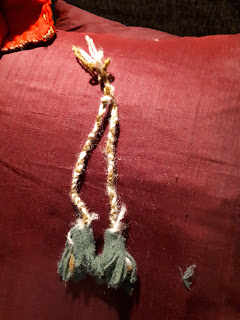
The finished braids.


The braids with tassels are sewn to the front of the hood. There has been an argument about their purpose. If they were made for tying under the chin, then the right tassel would have needed to be a lot longer than the left one. Lövlid argues that instead they were possibly tied behind the head of the wearer, to open up the hood and make it easer to see. It is also possible that they were just there for decoration.

Decorations

On the original hood there are a few strands of thread left quite high up under the top seam on both the left and right sides. They are not connected to any other seam, and the thread is clearly visible against the fabric. The thread is very loose.  Lövlid speculates there might have been some kind of decoration added to the hood. I chose to add a small glass bead on each side. This is in style with Norse decorations, but if the hood is more connected to the Sami culture I think that some decoration in silver would have been better.


The finished hood


Me wearing the hood with the side braids left hanging

 Me wearing the hood with the braids tied in the back. The tassel also helps so that I didn't need to make a full tie or bow, I simply twisted both braids around each other and the tassels kept them from unraveling.


The fit of the hood


The hood is tight, it will possibly loosen up with wear, but now it's snug. I should not wear any elaborate hairstyle under it, since it is going to be ruined when I pull it on and off. The snug fit will be comfortable when it's cold and windy. To tie the braids behind the head definitely helps with making the field of vision bigger.

The collar portion is not very well fitting. Even if I am about the same height as the person that was buried, I have a bigger chest, and possibly wider shoulders. It bunches up and doesn't lie flat around the upper body at all.

Some reflections

This was an interesting project. I would actually say the quality of it is worse than what I would normally make. I would not do such big and uneven stitches, and I would use waxed linen thread instead of wool. Copying a piece that I feel is of not the best workmanship was a good experience though, and it made me realize that the quest for perfection that a lot of us costumers have, actually isn't always the most accurate method of working. Seams can be badly done, but still serve to keep the garment together, and then they are good enough. 

Just the facts

The Challenge: 8 - extant original

Material: 1 m of red wool twill
Pattern: From Lövlid's thesis on the Skjoldehamn find
Year: 11th century
Notions: thread: wool thread, yarn, two beads
How historically accurate is it? This is the most accurate piece that I have ever made, it still has some speculation in it and I am not sure on how my thread would hold up to VIking age thread. I will put it up as 90% accurate
Hours to complete: 10 hours
First worn: August 11th at Medieval Week in Visby.
Total cost: From my stash


Final thoughs
Accurate, but not good looking. That was the general reaction when I wore my hood on the one cold and rainy day in Visby. At the moment I'm not sure if I'm going to keep it in this state, or if I should remake it into something better looking. I would lie to make a more even bottom edge, add some larger gores and possible change top seams. At the same time it is fun to have a garment that's ugly, but it's supposed to be that way. We will see what happens with it in the future.

Tuesday, 31 July 2018

A viking for Visby

This year I'm going to the Medieval Week in Visby for the first time. Since I haven't done a lot of medieval costuming I realized in the spring that I wouldn't have enough clothes for a full week. I then decided that I would do a quick viking costume before the event.

I cut out the shift earlier in July, it's a basic square pieces with gores shift. I will say though that for a busty girl like myself this is not the best shift. It's really tight over the bust, since the gores are too narrow at the top to widen it over the bust, and if I want to make the front piece big enough to be roomy over the bust, well then the shoulder seam end up almost at my elbow. It works though, even if it's more medieval than viking, and not as roomy as I had planned. It's made in unbleached linen, I have sewn the main seams on machine, but felled and hemmed it by hand.

Over the shift I've done a classic Viking apron dress. I made it from the leftovers of the green wool of my 1520's outfit, which also dictated how wide I could make the dress.

Instead of using a pattern I cut the fabric in four equal pieces. There are finds from Hedeby/Haithabu that show that the dress were made with shaped pieces and not just squares. I then simply pinned the fabric until it was tight just above the bust. I made it just tight enough that it almost falls down, but not quite. Under the bust I made an angled seam that met the edge of the fabric, to get as much width as posible out of the fabric. I'm not totally happy with the fit, but it will do, and I can adjust it later. All the long seams are sewn on machine, and since the wool doesn't fray I haven't done anything to finish the seams on the inside. That is also in case I want to adjust it later. It's hemmed at the top and bottom by hand.

The dress is held up by two sets of straps. Each strap is made of two loops of fabric, the same as the dress. The shorter loop is at the front and th longer in the back, I've placed them approximately where on the same place as bra straps.


tt
The loops are connected by brooches in the front.

All vikings love bling, so of course I needed to bling up my costume. I started with the decorating the front with a piece of yellow silk, leftover from my handmaiden gown. The strip of silk is a nice background to the beads that I added in the front. The beads come from three different necklaces that I already had, but never used.

The green beads are proper reproduction of viking beads. They are a prize from when I was 11 and competed on national TV with my knowledge of vikings. (Kvitt eller Dubbelt for those Swedes who remember that show). I failed on the last question so I never got the prize money, but I got the full prize table, wich included these beads. The necklace with blue and yellow beads are bought at a Viking market, so at least inspired by proper viking beads, the topmost necklace are just random beads. I strung the beads up on a piece of leather string, and got rid of the most modern looking beads.


This is the finished ensemble. My tortoise brooches are the most glaring inaccuracy, since they are way too small compared to actual finds, the also have a modern pin in the back instead of the hooks that should connect the loops of the straps. Still they cost a fraction of the prize compared to a proper pair of tortoise brooches.

All in all it took me a day to make the apron dress, the shift has been a work on and off during the summer. It's a passable Viking costume, and that was my goal with this costume.