
HSM Challenge 5 - pleats, tucks and trims
Make a garment or accessory that is either pleated to create shaping, or features pleats, tucks or trims as embellishment.
For my early 17th century wardrobe I really wanted to make a black cap. These black caps are seen in portraits of Swedish priest wives.

They are also common in Dutch art from the middle of the 17th century, a little later than my intended time period.

I really had to go with artistic inspiration for my own cap, since I couldn't find paintings that showed the back, or surviving extant examples. The general shape is quite close to the the cap that is worn with most Swedish traditional costumes - "bindmössa". A bindmössa is usually made out of silk and mounted on an interior made from stiffened paper or fabric. The undercap has been changed into a loose piece of white fabric, usually with lace or embroidered, that is pinned in place before putting the cap on.
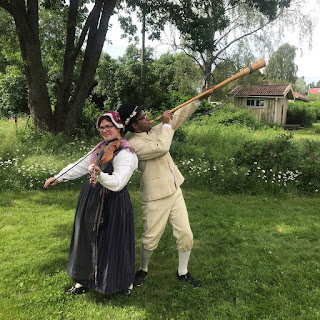
This image shows me wearing my cap together with my folk costume. Thankfully for these traditional caps there are patterns available online. If you are interested in traditional costumes I really recommend the site Digidräkt.se. It is a site dedicated to the costumes worn in Ovansjö parish, but they also have lot of free patterns made from extant pieces from mainly the 19th century. These patterns are great starting points for quite a few pieces that works for several time periods, including bodices, skirts, shirts, trousers and sewn and knitted hose. I printed their pattern for the skarpmössa/bindmössa. It is a cap that is made to fit snuggly thanks to several pleats in the back.
I first made a test version out of scrap wool to test the size. It is unlined, but bound with a strip of bias from the same fabric. The bias strip was important to make the edge firmer and keep its shape. It worked great, but I felt that it was a bit on the smaller size, especially when I put my hair up in a bun in the back.. I will use this as a more simple, poorer cap though.


So the pattern worked, now it was time to make the final version.


I started out with cutting the original pattern in four parts and spreading them out. The second image shows the new pattern in blue, compared to the original paper pattern.

I used cotton canvas as the foundation layer. Since blue canvas isn't historically accurate and since it wouldn't be seen I sewed it together on the machine. The original pattern had three pleats on each side, but with this larger pattern I added two more to get a good fit, for a total of five pleats on each side.


The outer wool layer was constructed just like the lining, but here I made five pleats on each side in the back.


Just the facts
How it fits the challenge: It is shaped by pleats in the back to create a tight fit
Material: 0,5 m wool cloth, 0,5 linen, 0,5 cotton canvas
Pattern: Based on a traditional cap from Ovansjö socken, available at digidrakt.se
Year: 17th century
Notions: Linen thread for the lining, regular sewing thread for the canvas and silk (because it's the only black thread I had) for the wool layers
How historically accurate is it? Very hard to say since the pattern is 150 years wrong, and it is very much my thoughts on how it might have been constructed in the 17th century to get the cap we see in art, also the canvas is a modern fabric and that part of the cap was sewn on machine, so maybe 30%
Hours to complete: One evening
First worn: Will be worn at Vadstena Military days April 17-19
Total cost: $30
