Showing posts with label historical costumes. Show all posts

Wednesday, 11 December 2019

Fake it 'til you make it part 2

Something I can recommend for any museum is to reach out to historical costumers and recreators, are they willing to come and help by showing up in costume? This year we had decided to stage some historical scenes set in 1719. I reached out to my colleagues in Sala, the ones who invited me to my very first 18th century event, since I knew that they are actively working with recreating the 18th century. December is a very busy time for them but two of them showed up in costume.

The man's outfit is based on a picture of a map from 1683, and that is a picture I had as a reference as well when I wanted to create a working man's outfit for the late 17th and early 18th century.

The other reference is the woodcut of Fet-Mats Israelsson, who's the reason we had picked the year 1719 for our dramatizations.


I am pretty happy with the costumes that I managed to fake for "our" characters


In Sweden we don't have any webshops that sell 18th century clothing, but we have a lot of viking/medieval shops. Our miners are actually wearing Torsbjerg-trousers, since they were the best wool trousers we could find. To simulate the trousers being breeches they wore either knitted legwarmers or wool legbinders (also viking but it looked good).The vest is from our storage, and it's really nice with proper copper buttons. It is winter though, so they needed some kind of jacket. I made a very quick unfitted jacket, that was basically just a fabric folded double and cut in a T-shape. I then cut off the sleeves so I could make them a bit more shaped and slimmer, and sewed them on again.

The least accurate costume was for the head administrator. Already when we started planning the dramatizations I said that we would not be able to make or buy an upper class outfit. Everything was resolved when we were told that we could borrow a costume. Phew! Then one week before the fair it was clear that we would not be able to borrow the costume as we had thought, so I had less than a week to come up with something.  Based on the portrait of the head administrator I decided that we needed to get some things done so that people only saw the focus details, and not the rest of the costume. I decided that a wig and tricorn hat, a cravat and a vest in a bright colour would make him stand out against the workers.

I have described the work with the wig here. It is a cheap party wig, sprayed white and powdered. For the vest I found a remnant of fake damask fabric in our storage and made a very simple pattern for an early 18th century vest.

I didn't have enough fabric to get it quite as wide in the skirt as I had hoped. I also found some gold braid, and since this vest was a 2 hour job on Friday afternoon I really cheated. Instead of hemming the vest I just zigzagged the edges and put the trim over it to hide the stitches.


I actually think it looks best from behind
 There was just enough trim that I could also take one of our black round hats, apply the gold trim and turn up the brim to create a tricorne from it. The trousers are simply called "fantasy" trousers, that we had in storage, and he brought his own jacket. The jacket was quite short though so he chose to tuck the vest into the trousers to make it even with the jacket. To finish it all off he wore one of my linen veils as a cravat.

accurate, fake, plausible
I must say that in the end it looked fairly good, as long as you stood some distance away.

The drama is in full swing - Fet-Mats has been found after 42 years.


Sunday, 8 December 2019

Fake it 'til you make it

I started to write this post, and after a while I realized that it was getting really long, so I have split it up in several parts. This first part is my explanation to why historical costumers quite often get disappointed when visiting museums.

Historical costuming is my hobby, in my professional life I work at a museum. More often than you might think these two aspects come into conflict. The museum I work with is on a journey to provide more living history as part of the experience, and I am one of the persons responsible for doing that. That work has led me to reevaluate my opinion of many other museums, and their attempts at providing historical costumes. I've also seen a few posts lately expressing dissappointment on historical costumes seen on museums.

Living history done well- The publisher's house at Skansen.
The truth is, with very few exceptions museums rarely have the possibility to achieve historical accuracy, instead they have to go for what I have decided to call historical plausability. This is not just a question of time and money, very often it is also a question of knowledge. The museum where I work is very much a technical museum, my colleagues  are very knowledgable, have university degrees and an interest in the past, but they have never studied fashion history. I do not consider myself an expert in the fashion of all time periods, but I can see the difference between a 17th and 19th century outfit, and to be honest most of my colleagues can't. Just like I can't tell the difference between different kinds of window frames, because I don't have an interest or haven't studied them, while my colleagues have done that. This is also a question of training your eyes to see differences in cut and details. I like the to tell the story of when my sister showed me the two dresses she wanted to use as inspiration for her wedding gown, one of them had a pleated skirt and one was a full circle skirt, but to her they looked the same. She didn't see the difference, and that is also the case with many people who have not looked at and studied pictures of fashion like historical recreactors, costumers and cosplayers do. So knowledge is a very large reason why many museums usually don't provide costumes that are historically accurate, they might simply not be aware of it.

Even with knowledge of what a costume should look like, the sad thing is that accuracy costs. I work in a museum that is both old and big enough to have the possibility to have a costuming budget. With old that means that over the years we have aquired costumes or rather pieces of costumes. We have a storage where we have kept things, it's in the size of two movable wardrobes, but at least it's a basis. The pieces are of very varying quality, but there have been some really nice things done, but they are also from very varied time periods. Currently we are working on two tracks when it comes to living history. One will be a permanent thing that will also be set in a time period where there is a big enough interest for historical costuming that there exists stores selling good quality clothes. There I have gotten a budget to buy what we need. The other track is our annual Christmas fair. Since last year we have worked to give it a more historical atmosphere, set in the late 19th early 20th century, but we also add small historical scenes set to a particular year. Last year it was 1695, this year it was 1719, and next year...well it will be a totally different century. It is not feasible for us to spend a lot of money on clothes that will be worn once and maybe not in a long time after that.  This is where I dig deep into the storage and need to come up with ways of basically faking historical fashion.
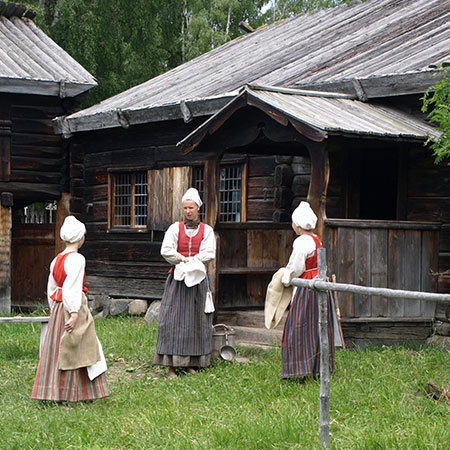
Living history done well - Lillhärdalsgården at Jamtli
The third issue that affects a museum's costumes is time. Few smaller museums, like ours, have a costuming department. In our case the costuming department is me, and a colleague with a budget that allows her to buy premade things. If we want to produce something though, it generally comes down to what I can do.  I can do it on my work time, but I also have a lot of other things to do so my time is limited when it comes to how much I can spend on sewing. Unlike some of my private costume projects where I don't count the hours at all just make sure that I get things right. Still the fact that my museum has a budget for costumes at all, and have a person that is interested in historical costuming puts us at a great advantage compared to more museums than you migh think. My goal is to make sure that our characters have a plausible silhouette, even if I can't make accurate costumes. I need to take my knowledge of historical fashion and concentrate it into something that workds, even if a lot of it is put together from pieces that are by themselves totally inaccurate. I call this historically plausible rather than historically accurate. (and yes it hurts the historical costumer in me but it is the reality that I live with).

It should also be said that in many cases the museums that are well-known and respected for their living history programs, in Sweden we have Skansen and Jamtli for example, have been doing it for decades (or in Skansen's case more than a century) to build up their knowledge and their costuming departments. I might work at Sweden's oldest technical museum, but we are just beginners when it comes to living history.

With these limitations in mind, in the following posts I will talk about how I worked with the costumes for the characters during our Christmas fair.


Wednesday, 16 January 2019

Some research for 16th century Sweden

I'm currently more involved in a non-costuming project than I am in my costuming, so there isn't much crafting going on. I'm slowly working away on the Enfys Nest jumpsuit and waiting for my hard parts to arrive for her.

Research is something I can do in the breaks for the other project though, and I have continued my quest to recreate early Swedish 16th century, or to be even more precise the dress in the Bergslagen region.

The problem is that there are few images and sources, the earliest portraits and paintings are from the 1530s and show the royal family and high nobility. And even if it's clear that a lot of the fashion was imported from Germany I don't want to just imitate Germany fashion and hope that it will be correct.

Over the weekend I decided to once again go through images of church art. For that I used "Medeltidens bildvärld" - which is a site from the Swedish History Museum with collections of church art. The great thing is that it's divided up by county and parish, so you can go through quite exact geographical areas. For this I chose to go through the counties of Dalarna, Västmanland, Uppland, Södermandland and Närke, or basically the wider geographical area of Svealand. I also limited my search to pieces that were dated to the first quarter of the 16th century.

When it comes to church art there are two main kinds of arts; paintings and sculptures, usually large altar pieces. The altar pieces contains a lot of figures, but they are usually imported. In the early 16th century most of the altar pieces came from the Low Countries, meaning that they do not necessarily reflect the local fashion.

Altarpiece in Västerås cathedral, made in Antwerp

You do get some lovely costumes on the altar pieces though. I absolutely love the quilted baseball cap on the woman to the right, or the woman to the left that is wearing what to me mostly looks like Padmé's pilot helmet from Attack of the Clones. I have a pinterest board with some of my favorite fashion from altarpieces made in he Low Countries here.

The church paintings are different though. They had to be painted on site, and even if the artist might have been an expert craftmen from somewhere else he is more likely to paint what the people around him was wearing. Looking at church art in general it's also important to look at what they are portraying. Some saints and other holy figures have almost like a uniform that is differerent from the current fashion. You are more likely to find representations of local fashion in scenes depicting groups of people.

A popular scene to illustrate is the parable of the ten virgins, showing the bridesmaids in all their finery.

Söderby-Karl, Uppland

There are also paintings showing biblical feasts.

Dannemora, Uppland

Here is the whole family with Herod, his wife and Salome with the head of John the Baptist.

From time to time images of more ordinary women crop up as well, like these two fighting.

Dannemora, Uppland


or this woman churning butter with the devil

Dannemora, Uppland

I have a pinterest board with church paintings from Svealand here. I will definitely use it as inspiration for my 16th century projects.

Friday, 2 September 2016

Work trip to Röros, Norway

I've been on a work trip to Röros for the last few days. It was mostly about seeing how they work with their mine museum and building conservation. The program was really packed, but there were some costuming related stuff as well.

On the way there we stopped at Härjedalens Fjällmuseum, which is a regional museum for Härjedalen. It's a small museum, but really nice, and they had one part about the dress of the people in Härjedalen. Härjedalen is very much a transit region, basically in the middle between the Swedish Baltic coast and the Norwegian Atlantic cost, and it's reflected in how they dressed. The clothes were very much of the latest cut, and there were a lot of them. A typical woman in Härjedalen in the early 19th century regularly owned around 100 different articles of clothing. Status was all reflected in the clothes, so even if you lived in a shackle, you made sure to look good before going out.

I really liked these three bodices from around 1820. The regency waist line is obvous, since the bodices are really short. The fronts are wrapped over each other, and I guess pinned in place. I really enjoyed seeing the closure, since I haven't seen too many bodices displayed with the back towards the viewer.

In the mining museum in Röros they also have a costume exhibition, unfortunately it was really hard to take photos there, and I only had time to rush through it.

I really fell in love with this red quilted petticoat. I couldn't find a date for it, but most of the clothes were from around the middle of the 19th century. I would love to have a quilted petticoat like that for my 18th century wardrobe though.


It's hard to see but this jacked from around 1830 was the thing I was most impressed with. The very wide sleeve has been gathered with perfect stroked gathers into the narrow arm scye.

Overall I can really recommend a visit to Röros it's a very beautiful town with a fascinating history.


Monday, 6 June 2016

DUHMP June 6 2016

Today it's June 6, which is Sweden's National Holiday. Most Swedes don't really care about it, it's nothing like May 17 in Norway or July 4 in the US. In fact it's just 10 years ago since it was turned into an actual holiday so people could get the day off from work. If the weather is nice it's a really good reason to have a picknick though, and for the last years there has been "Den Ultimata Historiska MegaPicknicken" (the ultimate historical mega picknick) or DUHMP in Hagaparken in Stockholm. I've have been working the last June 6, which of course happens when you work at a place that is used for June 6 celebrations, so I haven't been able to attend. This year I was free though, and since a very good friend of mine put forth his dissertation for a PhD on Saturday I was in Uppsala, so it was an easy decision to stay until June 6 and go to Stockholm.

Some weeks ago I planned to inaugurate my 16th century undergown for this event, but I've always wanted to go to the event in 18th century attire, since the weather promised to be really nice (sunny and in the low 20s) I felt that my best summer dress would be the gaulle. The gaulle also has two other advantages; it's easy to pack since it's just cotton voile and I can use my shortest pair of stays with it which is a good thing if you know that most of the event will be spent sitting on the ground.

I talked to Carolina/Lithia Black so that we could meet up at the entrance of the park and find our way to the picknick. When we met up it was quite fun how well we matched, despite having chosen fashions 100 years apart.


I also wasn't the only one who had picked red shoes to wear. I can only say how much I love my American Duchess Kensingtons. I have some very painful calluses on my feet from other shoes, and the Kensingtons were the first pair of shoes in a couple of days were actually comfortable to walk around in. The sole is a bit thin though, so for longer events I should probably put an extra sole inside them.
The great thing with the event is of course the total mix of of eras. It was really nice meeting all these serious reenactors, who had brought period correct kitchenware and food to the picknick. That's why I still consider myself as a costumer first, since I don't go those kinds of events where you live and breathe history, I enjoy just dressing up.

There were some gorgeous 18th century costumes, my hair and hat felt tiny in comparison.


I had expected the event to be dominated by 18th century and the Middle Ages, but outside of the vikings, in their very comfortable loose linen clothes, I felt that the 19th century dominated with everything from Regency to Edwardian.


It's the mix of eras that makes this such a fun event though.

Just before I had to leave to catch the train back to Falun they also started with some Regency dancing.

I had time to take part in two dances, then it was just for me to leave. Unfortunately I missed the main group photo, and if I can take part in this event next year I think I need to come up with a way that would allow med to stay in the evening as well, I definitely had a feeling that the picknick was only starting when I left, despited that I had been there for almost four hours.

All in all it was a great day, now I just need to untangle the messy state my hair is in, after all the curling and teasing, and then it's off to bed.